Automotive assembly runs at high volume and high frequency, on production lines where a single inconsistent batch can stall the line. That makes batch-to-batch consistency as critical as the fastener's own strength rating — a supplier who can't hold tight tolerances at scale becomes a line-stoppage risk, not just a parts risk.
Fasteners also have to hold under continuous vibration over the vehicle's service life. A standard hex nut relies on thread friction alone to stay in place — under sustained vibration, that friction gradually breaks down and the nut can back off. This series is built around locking mechanisms and specialty nut types that address that failure mode directly, rather than standard hex nuts alone.
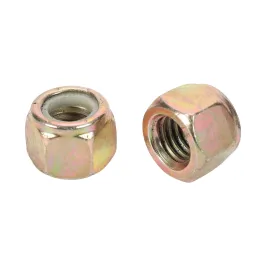
■ Nylon Lock Nuts Carbon Steel / Brass
A nylon insert creates friction against the bolt threads, resisting loosening under vibration without damaging the threads — the standard choice for most vibration-prone joints.
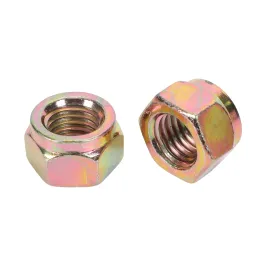
■ Metal Lock Nuts Carbon Steel
An all-metal locking mechanism gives the same vibration resistance as a nylon lock nut, but withstands higher temperatures — used near engine or exhaust-adjacent mounting points where a nylon insert would degrade.
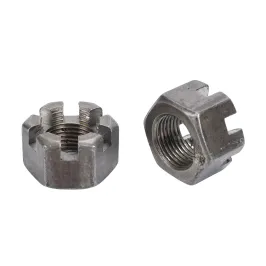
■ Slotted Nuts Carbon Steel
Secured with a cotter pin through slots in the nut and a hole in the bolt, giving a positive mechanical lock for critical connections where friction-based locking alone isn't considered sufficient.
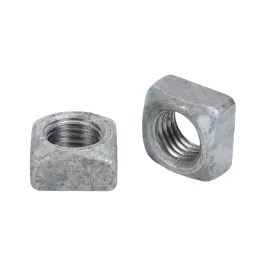
■ Square Nuts Carbon Steel
A larger bearing surface and flat sides resist rotation, useful in tight assembly spaces where a wrench flat can't be held on the nut side.
For full specifications on each product, see our Nuts and Bolts pages in the Product Center.
High-vibration mounting points where sustained road shock makes loosening resistance a baseline requirement, not an upgrade.
Fixtures near heat sources, where an all-metal locking mechanism holds up where nylon inserts can't.
Panel and trim fastening at high line speed, where consistent torque and batch uniformity keep automated assembly on schedule.
Tight assembly points where a standard wrench flat can't be held, calling for a nut profile that resists rotation on its own.
Need standard fasteners instead? See our General Fastener Series, or browse the full range in the Product Center.


 Filter